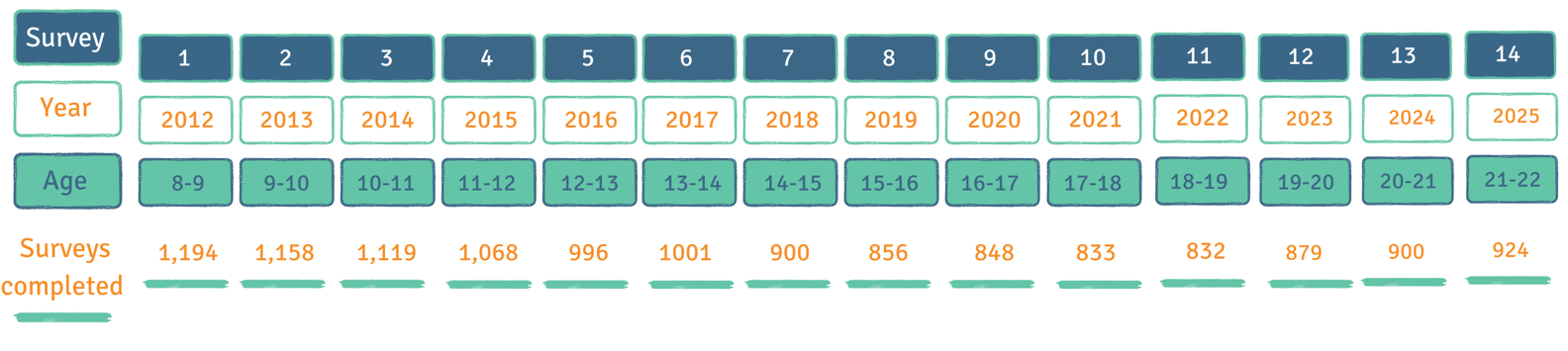
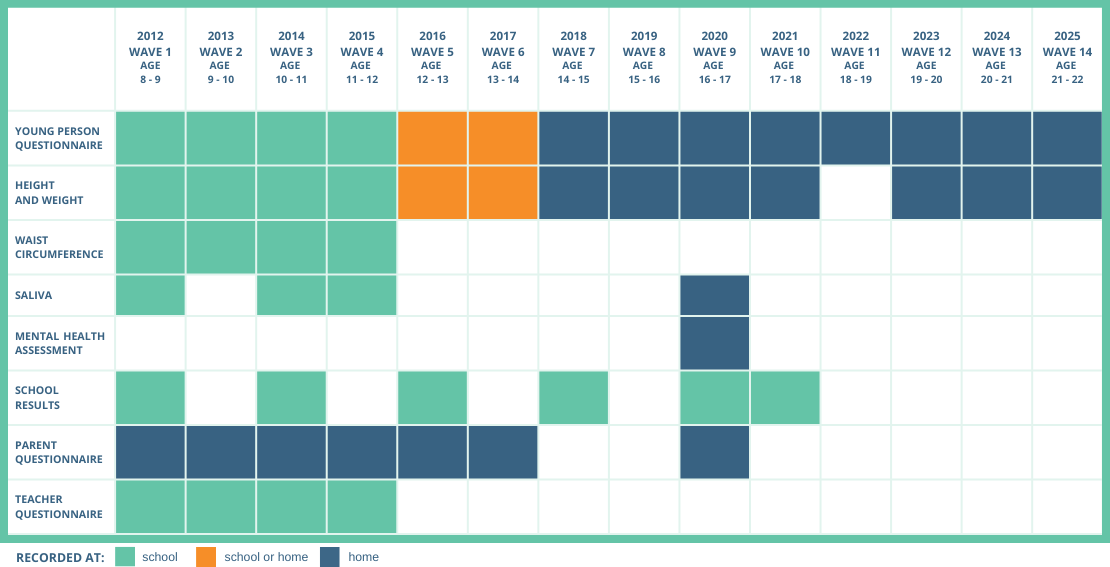
In 2026 we will be in touch with our participants for the 15th time. CATS began in 2012 with our first survey. Below you can see each CATS survey in order including the year, the age of our participants, and how many surveys were completed.
CATS investigates various factors that influence young people’s health and development, including behaviour, physiological changes, social contexts, emotional wellbeing and health care. The information we collect allows us to investigate how these factors independently affect health, but also how they interact. The research supports program and policy makers plan effective and evidence-based interventions and prevention strategies for young people. To date the research has investigated topics such as:
Our latest investigation has been into the evolution of anxiety and depressive symptoms from ages 10 to 18 years. We are currently advancing analyses on:
The Imaging Child to Adult Transition Study (iCATS ) is an extension of the larger CATS study looking at how the brain develops across adolescence and into young adulthood, and some of the things that influence its development.
The developing brain changes dramatically from puberty to the mid 20s. This brain development is critical for health and wellbeing. MRI brain scans are being taken of a small group of CATS participants to help us understand what supports healthy brain development, particularly the role of parents, friends and close others.
Dr Nandi Vijayakumar is the Principal Investigator who oversees iCATS, based at the Centre for Adolescent Health at the Murdoch Children’s Research Institute (MCRI) within the Royal Children’s Hospital (RCH) and Deakin University.